
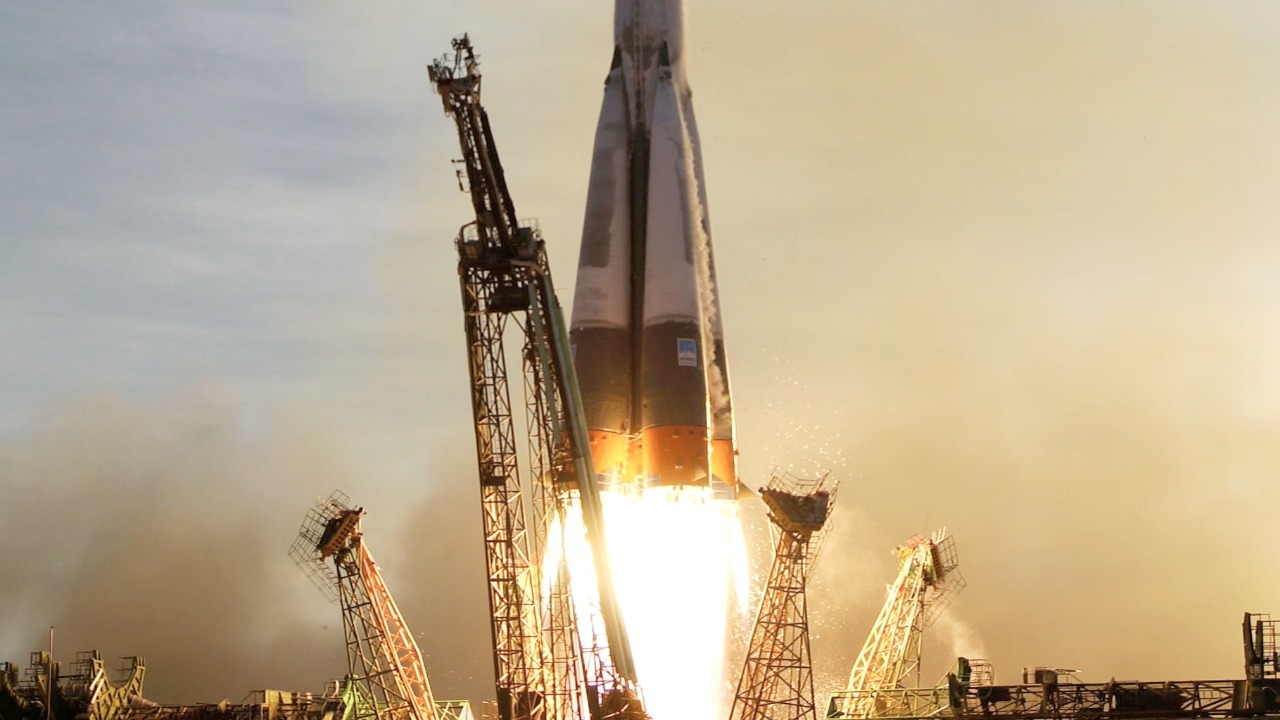
Russia’s only operational launch pad for crewed Soyuz missions has suffered significant blast damage, abruptly turning a routine liftoff into a strategic crisis for the country’s human spaceflight program. The incident has raised immediate questions about how quickly the pad can be repaired and whether Moscow can maintain its commitments to the International Space Station without interruption.
As engineers survey the wrecked concrete and twisted infrastructure at Baikonur Cosmodrome, the episode is exposing how dependent Russia has become on a single aging facility to send its cosmonauts into orbit. I see a story here that is not just about a damaged pad, but about a space power that has allowed its redundancy to erode at the very moment global access to orbit is becoming more contested and more commercial.
How a routine Soyuz launch turned into a ground infrastructure failure
The launch that triggered the damage began as a familiar scene: a Soyuz rocket carrying the Soyuz MS-28 spacecraft and its crew lifting off from Baikonur Cosmodrome in Kazakhstan on a mission to the International Space Station. The ascent itself appears to have gone according to plan, with the crew reaching orbit and heading toward the ISS, but the trouble unfolded in the seconds after liftoff when the exhaust plume and acoustic forces battered the pad’s flame trench and surrounding structures. According to early assessments, the blast tore up reinforced concrete, damaged cable runs, and scattered debris across the complex, leaving the site in far worse condition than after a typical launch.
Initial imagery and on-the-ground reports describe a scene of scorched infrastructure and collapsed sections of the flame deflector, suggesting that something in the pad’s protective systems failed to handle the rocket’s exhaust as designed. Analysts have pointed to the age of the facility and the cumulative wear from decades of launches as likely contributors, with some experts noting that the pad had already shown signs of deterioration before this latest mission. The scale of the visible destruction, documented in detail by post-launch imagery, indicates that this was not a minor spall or cosmetic crack but a structural event that will require extensive reconstruction rather than routine maintenance.
Baikonur’s Pad 1 and Russia’s shrinking launch infrastructure
The damaged facility is not just any launch site, it is Russia’s only active pad capable of sending cosmonauts to orbit on Soyuz rockets. Known historically as Gagarin’s Start, the Baikonur pad has been the workhorse of Soviet and Russian human spaceflight since Yuri Gagarin’s pioneering mission, but over time other crew-capable pads have been retired or repurposed, leaving this single complex as the sole gateway for Russian crews. That concentration of capability has now turned into a glaring vulnerability, since any extended outage at Baikonur directly translates into a halt in Russia’s ability to launch its own personnel.
Russian officials have long talked about shifting more activity to the newer Vostochny Cosmodrome in the Russian Far East, but the infrastructure there is not yet fully certified for crewed Soyuz flights, and the necessary life support and emergency systems remain incomplete or untested for human missions. The result is a human spaceflight architecture that leans almost entirely on one aging pad in Kazakhstan, a dependence that was already risky before the latest blast damage. Reporting that describes Baikonur as Russia’s only active launch pad for crewed Soyuz missions underscores how little redundancy remains in a program that once boasted multiple crew-ready complexes.
What we know about the damage and the repair challenge
Early technical assessments suggest that the blast carved deep into the flame trench, shattered concrete slabs, and may have compromised structural supports that channel exhaust away from the rocket during liftoff. Engineers are now inspecting whether the underlying foundations were affected, since any weakening there would complicate repair timelines and could force more extensive reconstruction. The damage also appears to have affected power and data lines that run through the pad area, which are essential for fueling operations, countdown control, and safety systems during launch campaigns.
Repairing a launch pad is not as simple as pouring new concrete, particularly when the site must withstand the intense thermal and acoustic loads of a Soyuz booster. Specialists will need to remove damaged material, assess rebar and support structures, and then rebuild with materials and geometries that meet strict engineering standards for repeated launches. Some observers have warned that the work could take many months, especially if the pad’s flame deflector and exhaust channel require redesign rather than straightforward replacement. Detailed accounts of the cratered trench and broken infrastructure at Baikonur, including the description of serious blast damage to the pad’s core systems, point to a repair effort that will test Russia’s already stretched space budget.
* Direct consequences for crew changes and supply operations on the International Space Station. * An instant effect on how crews are rotated and supplies are managed aboard the ISS. * The situation will immediately change crew schedules and supply transport to the ISS. * This has a prompt influence on the ISS crew rotation schedule and logistical support. * ISS crew rotations and resupply efforts will be affected without delay.
The biggest immediate concern is the impact of the damage on crew changes at the International Space Station. Russian cosmonauts are vital for running the Russian Orbital Segment and handling propulsion and attitude. Soyuz vehicles are more than just transportation; they’re also emergency escape pods. Therefore, any slowdown in launch frequency could disrupt emergency return plans and long-term staffing. If the Baikonur launch site is out of commission for a long time, Russia will need to choose between postponing future manned missions, decreasing its presence in space, or finding other solutions with its collaborators.
NASA and its International Space Station (ISS) collaborators have broadened their access to space using commercial spacecraft such as SpaceX’s Crew Dragon. However, Russia has consistently depended on Soyuz as its only spacecraft capable of carrying humans. This imbalance now limits Moscow’s choices if it aims to keep its typical number of cosmonauts aboard the station. Experts suggest that any extended pause in Soyuz launches could necessitate changes to the ISS crew size and potentially impact scheduled cargo and upkeep tasks on the Russian segment of the station. The incident raises worries about how it might complicate…future space station operationsSpace policy specialists who monitor the intricate division of duties on the ISS are already raising these issues.
Russia’s reliance on just one avenue for crewed space travel.
For a long time, Russia’s manned space missions have relied on just one route: Soyuz rockets taking off from Baikonur and heading to the International Space Station. This approach was effective as long as the launch site was dependable and the Soyuz system lived up to its image of being tough and reliable. However, the recent damage highlights how little room for error there is if something goes wrong on Earth. I believe this reveals a fundamental flaw that has been developing unnoticed, as limited funding and political goals have restricted investment in alternative infrastructure or new spacecraft for astronauts.
The days when numerous launch sites at Baikonur and Plesetsk were ready for manned missions are gone. Now, if Gagarin’s Start isn’t working, there’s no backup plan readily available. This is especially noticeable when you compare it to the increasing number of backup options in other projects. For example, NASA now uses several launch sites in Florida for commercial crew and cargo launches. Reports have described the Baikonur pad as…Russia’s only way to send astronauts to space captures the essence of this dependence, which now threatens to turn a single infrastructure failure into a national spaceflight standstill.
Formal responses, community announcements, and unspoken sentiments.
Russian space authorities have admitted to the damage, but they’ve portrayed it as a minor issue, not a critical one. They’ve stressed the success of the Soyuz MS-28 mission and the crew’s safe arrival at the ISS. Official communications have underscored the lack of injuries and the uninterrupted continuation of operations in orbit, while also assuring investigations into the launchpad malfunction and outlining repair strategies. This approach is typical, where authorities emphasize the positive aspects of the mission and minimize infrastructure concerns, even when visual information indicates a more significant problem.
Meanwhile, Moscow hasn’t offered much in the way of concrete schedules for getting the launchpad back in working order, nor have they outlined alternative strategies should the repairs take more time than anticipated. Outside experts and international watchers have tried to make up for this lack of information, emphasizing the extent of the observable damage and the fact that there’s no readily accessible alternative launchpad for missions with astronauts on board. Reports also highlight how theRussian cosmodrome was damagedFollowing the Soyuz launch, the difference is striking between the confident statements from authorities and the more reserved opinions of independent experts, who have observed comparable infrastructure breakdowns in different projects.
The political and economic importance of Baikonur to both Moscow and Kazakhstan.
The Baikonur Cosmodrome is not only a technical asset, it is also a geopolitical and economic linchpin in the relationship between Russia and Kazakhstan. Russia leases the site from Kazakhstan under long term agreements that give Moscow operational control while providing Astana with revenue and international visibility as a spacefaring host nation. Any prolonged disruption at Baikonur could therefore have financial implications for Kazakhstan and could prompt new negotiations over investment, safety standards, and future use of the facility.
For Moscow, this event occurs as it faces increasing pressure to prove its technological prowess and independence in space, especially given that Western sanctions and changing partnerships are making it harder to obtain foreign parts and access international markets. The sight of a launch pad at Baikonur with obvious damage undermines the story of uninterrupted success since the Soviet Union’s space achievements. This situation might compel Russian authorities to consider whether the expense of quickly repairing the damage is worth it when compared to other budgetary needs. Accounts detailing theThe launch complex at Baikonur sustained significant damage.The rocket launch highlights the far-reaching impact of this event, extending from engineering to national pride and international relations.
Technical clues and open questions about what went wrong
Although the exact reason hasn’t been officially determined by investigators, the observed damage provides some technical insights. The fact that the most severe damage is located in the flame trench and exhaust channel indicates that the force of the explosion wasn’t properly distributed. This could mean there were cracks already present, obstructions in the ducts, or that the heat-resistant lining was weakened and collapsed under the extreme heat and pressure from the Soyuz exhaust. It’s possible that delayed maintenance or incomplete repairs of earlier minor damage left the structure vulnerable, and the most recent launch was simply the final straw for an already weakened system.
There are also questions about whether any recent modifications to the pad, changes in launch procedures, or variations in the rocket configuration might have altered the load on the infrastructure. Engineers will be looking closely at telemetry, high speed imagery, and post-launch inspections to determine whether the failure was purely a matter of aging concrete or whether operational factors played a role. Technical commentary that highlights the launchpad damage after the Soyuz liftoff underscores how much remains unknown, and how important a transparent investigation will be for restoring confidence in future missions.
What this means for Russia’s long term access to space
Beyond the immediate repair work, the Baikonur incident forces a broader reckoning with Russia’s long term access to space. A country that once prided itself on multiple launch sites and a robust stable of rockets now finds its human spaceflight capability bottlenecked through a single damaged pad and a single aging spacecraft design. If Moscow cannot quickly restore Baikonur or bring an alternative crew-capable pad online, it risks falling behind in a domain where new entrants and commercial players are rapidly expanding their presence.
The episode may also accelerate debates inside Russia about whether to invest more heavily in Vostochny, pursue new crew vehicles, or deepen cooperation with partners who can provide launch services. Each of those paths carries political and financial tradeoffs, especially in an environment where resources are constrained and international relationships are strained. Analysis that warns Moscow could lose access to space if the Baikonur pad remains out of action captures the stakes: without a reliable way to send its own people into orbit, Russia’s status as a leading space power would be more symbolic than operational.
More from Alpine Times
- Did archeologists find 10-foot giants in Nevada cave?
- Astronomers track object entering solar system at impossible speed
- Toyotas water powered engine could signal the fall of EV’s
- Giant underground structures uncovered on mars by NASA