The European Commission’s “Flightpath 2050” strategy aims to dramatically reduce aviation emissions over the coming years.
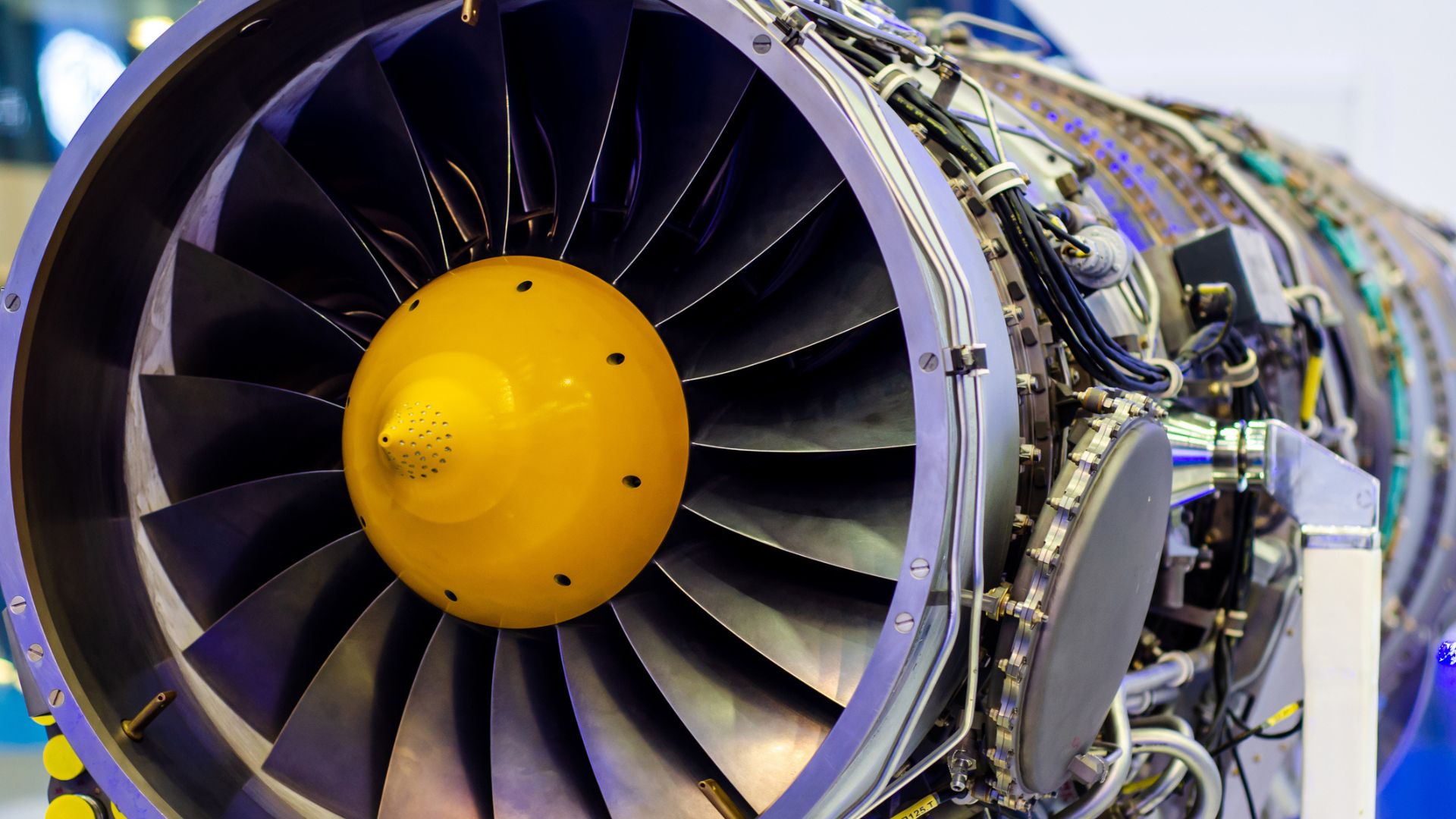
One of the technologies required to make this possible is more efficient engines. Now, with the ARIADNE project, a team at Graz University of Technology (TU Graz) in Austria has created a model that could help the EU to reach this goal much faster.
For their research, the scientists combined years of flow data on intermediate turbine ducts with AI and machine learning. This resulted in a model that massively speeds up the simulation of a wide range of geometry parameters in terms of efficiency.
Optimizing aircraft engines with AI
The team focused on intermediate turbine ducts, due to their potential for optimization. As project manager, Wolfgang Sanz pointed out in a press statement, “intermediate turbine ducts are an essential component of aircraft engines. They guide the flow between the high-pressure and low-pressure turbines, which run at different speeds.
“However, these intermediate ducts are quite heavy, which is why they need to be as short, small and light as possible while still achieving high levels of efficiency,” Sanz continued. “There is still a lot of potential for optimisation here.”
Over the years, TU Graz has collaborated with renowned aircraft engine manufacturers. In the process, it compiled a large database of measurement data and flow simulations related to the aviation industry.
The team behind the new model set out to use this wealth of information to optimize engine design. To do so, an interdisciplinary team at TU Graz tested three different AI approaches.
Ultimately, the most successful of these approaches turned out to be reduced order models. It searches for similarities in data and only uses the most common features for simulation. According to the TU Graz team, this leads to a dramatic acceleration of the required calculations. Though these models can slightly lower accuracy, they are orders of magnitude faster than a complete flow simulation.
In a press statement, the scientists explained that the model also had the ability to “quickly recognise changes in efficiency when a parameter, such as the length of the transition duct, changes.”
Tackling the aviation emissions problem
The research team is now planning its next steps. Firstly, it will make the extensive database on turbine ducts and its reduced-order model available online for other research groups to use. This will allow them to work on a three-dimensional simulation model similar to the one at TU Graz.
As Wolfgang Sanz pointed out, the team is already looking at starting new projects made possible by machine learning. “From the results of the machine learning approaches, we were able to recognise dependencies and trends that we would never have thought of otherwise.”
Aviation accounts for roughly 2.5 percent of global energy-related carbon dioxide emissions. Though this is a relatively small share of global emissions, the International Energy Agency reports that this number is expected to grow rapidly through 2030. As aviation is one of the most challenging sectors to decarbonize, AI and other state-of-the-art solutions are required to find the best path forward.