
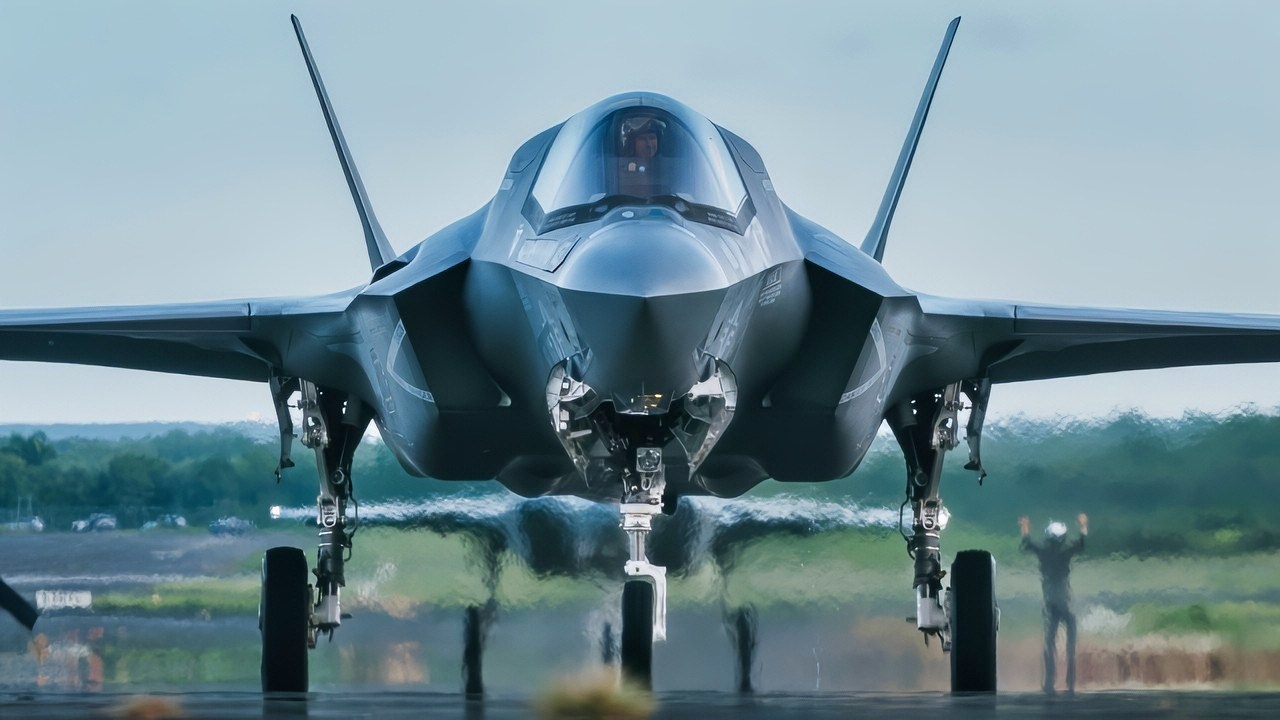
Key Points and Summary – China’s carrier-borne J-35/J-35A is being touted by state media as having a palm-sized radar cross-section thanks to shaping and metamaterials, prompting comparisons with the U.S. F-35.
-Concrete information is limited: the J-35 isn’t completely ready for action and its specifications haven’t been officially verified, leading to estimations that its radar cross-section is similar to the F-35’s, which is said to be about the size of a golf ball.
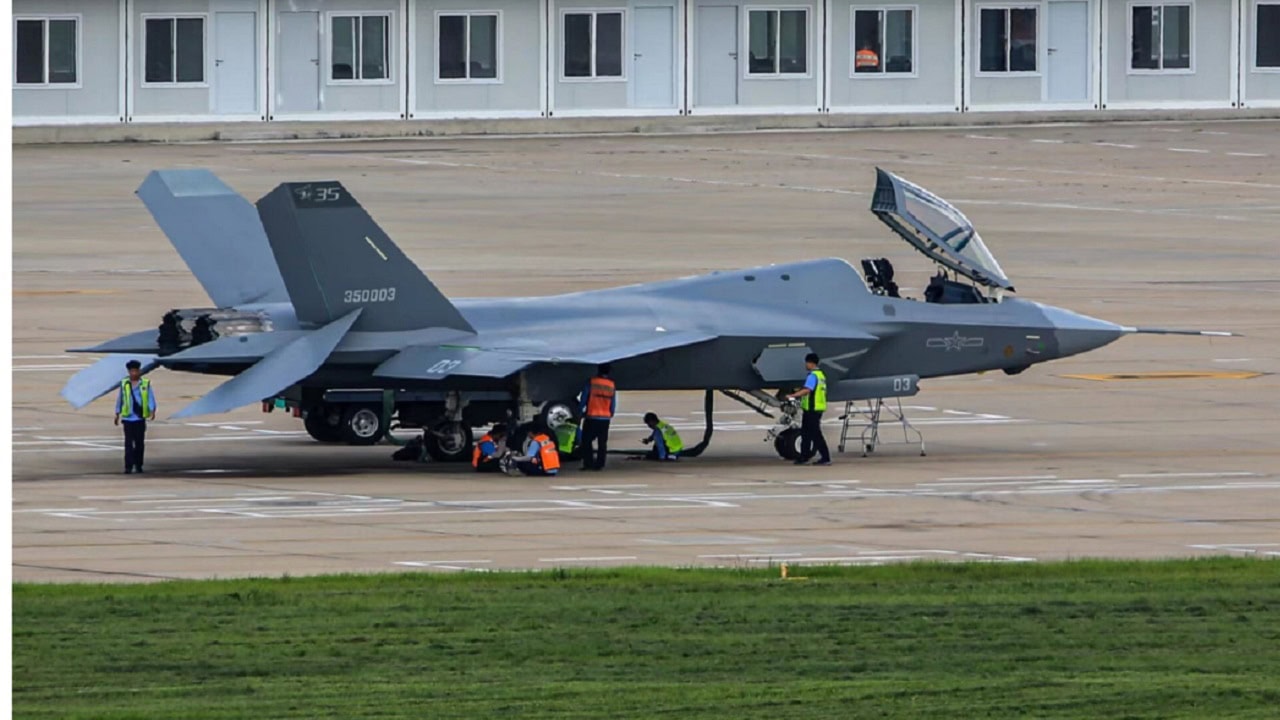
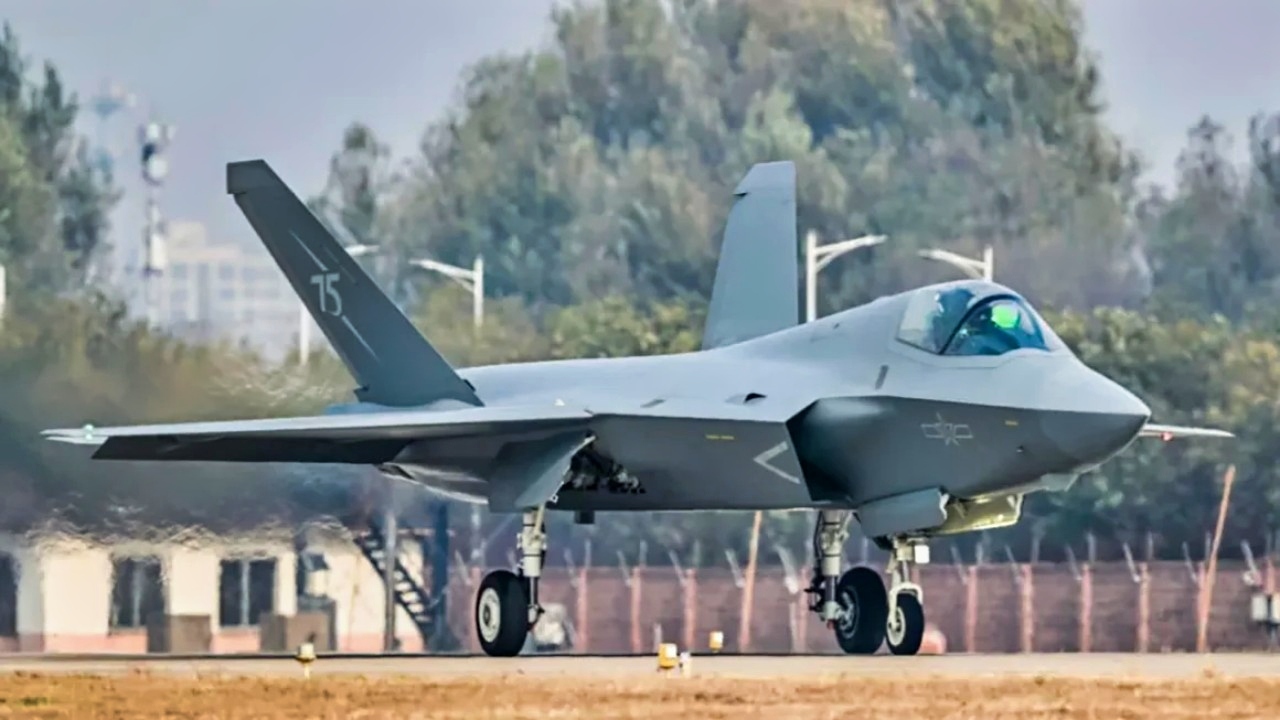
-Based on FC-31 dimensions, the J-35 appears slightly larger than F-35, but true stealth depends on shaping, inlets, edge alignment, coatings, and manufacturing tolerances.
-Until PLAN/PLAAF jets fly operationally and face allied sensors, claims remain unproven. The real answer will emerge in Indo-Pacific encounters, not propaganda—and measured performance.
The Great “Stealth 35” Debate: J-35 or F-35—Which One is Stealthier
Great power military competition is a game of one-upmanship. There are few better examples of this reality than the race between the United States and China to produce and fly the best fifth-generation stealth fighter jets.
What I call “The Great Stealth 35 Debate” pits the Lockheed Martin F-35 Lightning II against the Shenyang J-35. The U.S. Air Force flies the F-35A, while the Marine Corps has the F-35B, and the Navy has the F-35C. Meanwhile, the People’s Liberation Army Naval Air Force (PLANAF) flies the J-35, and the People’s Liberation Army Air Force (PLAAF) has the J-35A.
Beijing’s media mouthpieces claim the J-35 is stealthier than the F-35. Are they right?
Bottom Line Up Front (BLUF)
The basics come to us from a Sept. 28 article by Amber Wang of the South China Morning Post:
“China’s carrier-borne J-35 fighter has a radar cross-section smaller than a human palm, pointing to a big step forward in stealth technology, according to state media.
“The size of the cross-section – a measure of how detectable an object is by radar – was revealed in a programme aired on state broadcaster CCTV on Saturday.
“‘As a stealth fighter, the J-35 series’ low observability comes from its unique airframe shape and the country’s proprietary metamaterial technology,’ CCTV reported…’In the electromagnetic world, this ‘steel giant’s’ radar cross-section is smaller than a human palm.’”
Digging and Diving Deeper
Since the J-35 and J-35A are not officially in full operational status, we don’t know as much about them as we do about China’s other stealth fighter – the Chengdu J-20 Mighty Dragon is very much in operational service. Indeed, the J-35 series is so new that it hasn’t even been assigned a NATO reporting name yet.
So we resort to educated guesswork, including that utilized by the above-cited SCMP piece. Ms. Wang cites the Indian Defense Research Wing military website, which states that the Lightning II has a radar cross-section (RCS) of about 15 square centimeters, “about the size of a golf ball,” with the J-35’s RCS reckoned as falling within the 10-100 square centimeter range, “making it comparable to that of the U.S.’ F-35 fighter.”
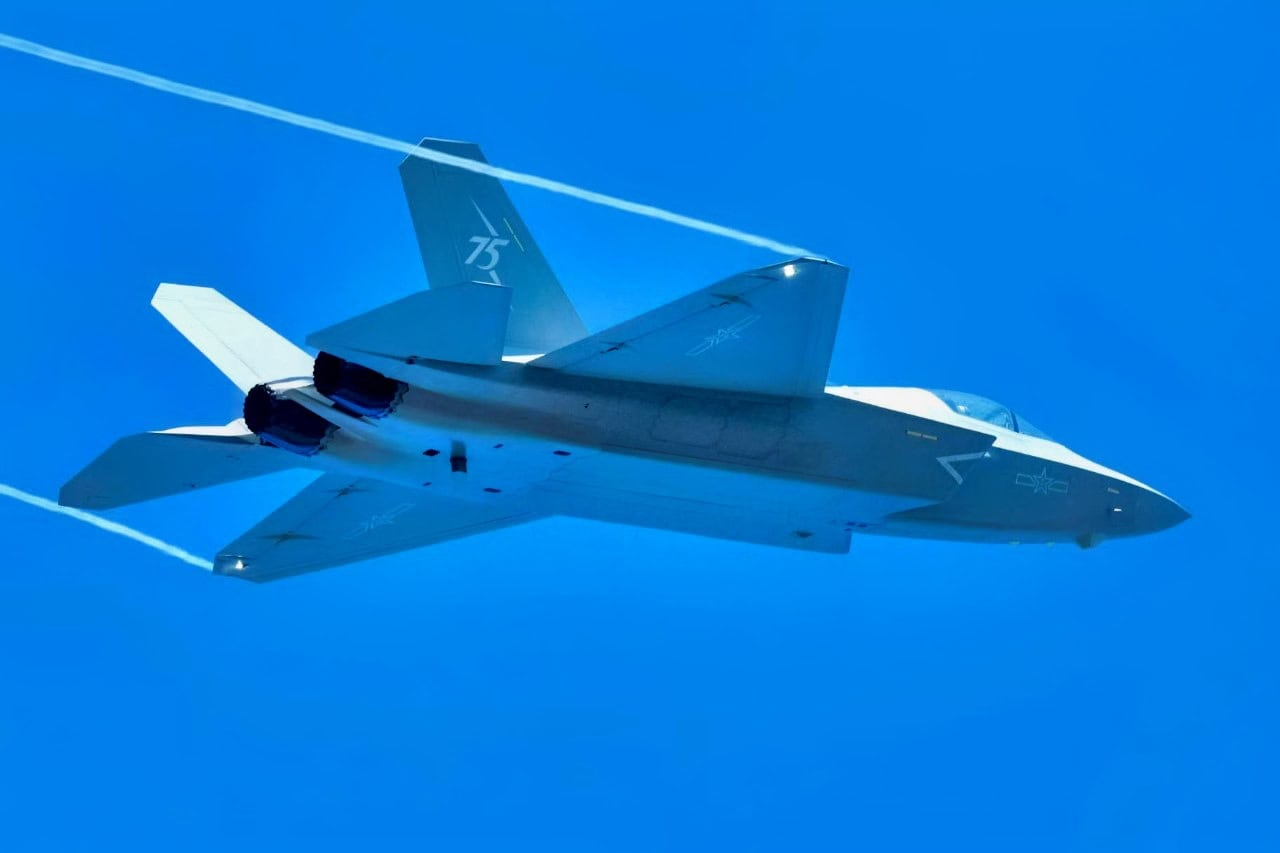
Meanwhile, for additional comparison, “the figure for China’s J-20 fighters was less documented, with estimates ranging from 100 to 1,000 square centimeters,” which, needless to say, doesn’t really narrow it down very much.
Additional J-35 vs. F-35 Size Comparisons
As already noted, exact tech specs for the J-35 are still not reliably available. But since the warbird is based on the FC-31 Gyrfalcon, we can draw upon the specifications of the latter Chinese fighter, courtesy of Army Recognition:
-Fuselage Length: 16.9 m (55.44 ft) for the FC-31; 51.4 ft (15.7 m) for the F-35
-Wingspan: 11.5 m (37.72 ft) for the FC-31; 35 ft (11 m) for the F-35
-Height: 4.8 m (15.748 ft) for the FC-31; 14.4 ft (4.4 m) for the F-35
-Maximum Takeoff Weight: 17,600 kg (38,801 lb.) for the FC-31; 65,918 lb (29,900 kg) for the F-35
If we go strictly by those numbers, and do not factor in the quality of radar-absorbent materials and other design characteristics, the Chinese stealth plane is slightly larger than its American counterpart.
Ultimately, rhetoric and propaganda machines aside, we probably won’t really know for sure until the PLAAF and/or PLANAF make their J-35s operational and start using them to harass American and Taiwanese assets in the Indo-Pacific region. At that point, the latter two countries’ radar operators hopefully are able to detect the newfangled Chinese stealth birds and assess the RCS accordingly. Time will tell.
About the Author: Christian D. Orr, Defense Expert
Christian D. Orr is a Senior Defense Editor. He is a former Air Force Security Forces officer, Federal law enforcement officer, and private military contractor (with assignments worked in Iraq, the United Arab Emirates, Kosovo, Japan, Germany, and the Pentagon). Chris holds a B.A. in International Relations from the University of Southern California (USC) and an M.A. in Intelligence Studies (concentration in Terrorism Studies) from American Military University (AMU). He is also the author of the newly published book “Five Decades of a Fabulous Firearm: Celebrating the 50th Anniversary of the Beretta 92 Pistol Series.”
More Military
No, You Can’t Make the A-10 Warthog Stealth
‘Flying Dorito’ A-12 Avenger II Aircraft Carrier Stealth Bomber Nightmare Had to End
The U.S. Navy’s Big F-15N Sea Eagle Fighter Mistake Still Stings
China’s New J-20S Stealth Fighter ‘Boiled Down’ To 5 Words
X-43A: How NASA Hit Mach 9.68 With an Air-Breathing Engine
Please follow National Security Journal on MSN for the latest news in defense, foreign policy, economics, and politics with a bipartisan twist.