

Serve Robotics Inc.’s SERV recent acquisition of Vayu marks a key step in strengthening its autonomy and efficiency roadmap. The company is building a robotics and autonomy as a service platform that brings together its autonomy stack, hardware and urban operations model. The addition of Vayu supports this framework by adding large-scale AI models and a simulation-powered data engine, helping the company accelerate progress in physical AI.
In the third quarter of 2025, the company advanced execution across operations, engineering and finance. The company expanded its fleet, enhanced the technology base and moved with greater precision. Vayu became one of two integrations completed during the quarter, positioning the platform to deepen its competitive moat. The acquisition brings expertise in urban robot navigation and is expected to improve model development and autonomy performance over time.
As Vayu is integrated into the autonomy stack, the company expects benefits that support leadership in autonomous delivery. These include lower data infrastructure costs, stronger operational metrics and faster model improvements. The integration also helps convert operational data into new monetization layers, reinforcing the company’s innovation position.
The company continues to invest in capabilities tied to autonomy and robotics, including the combination of Vayu and Phantom Auto. These moves support a broader goal to scale efficiently, deploy capital strategically and build a durable business in the emerging age of physical AI. The company highlights a strengthening flywheel driven by more robots, richer data and smarter AI, setting the foundation for long-term efficiency gains and improved economics.
Facing the Competition: How SERV Stacks Up Against UBER and DASH
Serve Robotics continues to expand its footprint in autonomous last-mile delivery, entering a space increasingly shaped by larger players such as Uber Technologies UBER and DoorDash DASH. Both companies have been investing heavily in automation and last-mile logistics, testing robotic delivery in select markets and partnering with startups to accelerate deployment.
Uber, through its Uber Eats segment, has piloted sidewalk delivery robots in collaboration with Cartken and Motional, aiming to reduce delivery costs and improve efficiency. DoorDash is also expanding the robotic delivery trials, leveraging its scale and strong merchant network to maintain a competitive edge. Serve Robotics may be more nimble, but Uber’s global delivery reach and DoorDash’s established infrastructure create meaningful competitive pressure.
As SERV increases the size of its self-driving vehicle fleet and broadens its operational scope, the central issue is its capacity to rival larger companies in terms of speed, dependability, and market reach. The established market positions of Uber and DoorDash may challenge Serve Robotics’ efforts to secure a lasting portion of the urban delivery market, despite its ongoing improvements to its autonomous technology and large-scale cost-effectiveness.
SERV Stock’s Price Performance & Valuation Trend
Shares of this leading autonomous sidewalk delivery company have surged 12.2% in the past year, outperforming the Zacks Computers – IT Services industry, as you can see below.
SERV’s Share Price Performance
Image Source: Zacks Investment Research
Looking at its valuation, SERV’s forward price-to-sales ratio is 36.46, which is considerably more expensive than the average for its industry, as detailed in the following section.
SERV Valuation
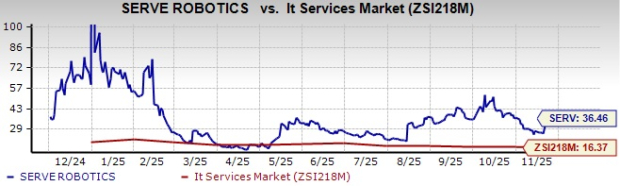
Image Credit: Zacks Investment Research
Projected earnings trajectory for SERV shares.
SERV’s projected losses for 2025 have increased to $1.55 from $1.30 in the last month. This projected loss for 2025 is greater than the loss of $0.67 per share that was recorded last year.
SERV’s Earnings Estimate Revision

Image provided by: Zacks Investment Research
SERV is currently rated a Sell by Zacks, holding a Rank #4.
You can see The full compilation of today’s Zacks #1 Rank (Strong Buy) stocks is available here..
This article originally published on Zacks Investment Research (Alpine Times).