

Artificial intelligence is disrupting the workforce, but reports about how that’s happening have been confusing, taken out of context—or used to prove doom-and-gloom scenarios that are unlikely to unfold.
Take, for instance, a study from Microsoft Research that was released in July. It looked at where AI could help workers, rather than where AI is being adopted first. But many interpreted it as a list of the jobs that were threatened most. (Historians are #2 on the list—are you guys OK?)
It’s only lately that researchers have had enough data on which people, in which jobs are actually using AI. This new wave of study says the revolution is happening in pockets more often than it’s taking hold across whole organizations.
In many firms, for example, there is a disconnect between those likeliest to benefit most from AI, and those actually adopting it. It’s often said that senior workers—who have the expertise to ask AI the right questions, and know enough to identify when it’s wrong—could wield it effectively. But they’re not necessarily the ones jumping on the AI bandwagon.
Workhelix, a consulting startup co-founded by academics studying the impact of AI on work, recently analyzed a pharmaceutical company with more than 50,000 employees. The team found that the employees using AI the most at the company were, far and away, the interns.
The lesson is straightforward, says Workhelix Chief Executive James Milin: Willingness to experiment, not the business role, is the most important factor determining workers’ eagerness to adopt AI. Age is an often imperfect proxy, since some young workers are anti-AI and actively work to thwart companies’ AI adoption efforts, he adds.
The other eager AI users at the pharmaceutical company were R&D scientists, which makes sense: Throughout their careers, getting ahead has depended on rapidly adopting new technologies.
AI adoption isn’t just a problem afflicting one company, but nearly all of them, according to researchers. The implication is that, as with tech waves past, startups full of keen young people have an opportunity to disrupt incumbents who may be slower to change. Within companies, people who could get the most out of AI might need the most encouragement, education and guidance to get there.
Solow’s Paradox lives
The consulting firm McKinsey—which is itself wrestling with disruption from AI—has been surveying executives about AI adoption for almost a decade. In its most recent report, McKinsey found that two-thirds of companies are just at the piloting stage. And only about one in 20 companies are what the consulting firm calls “high performers” that have deeply integrated AI and see it driving more than 5% of their earnings.
This relatively slow adoption speaks to the challenge of getting workers to use AI, even after the company pays for everyone to have access to it, says Michael Chui, a senior fellow at McKinsey and one of the authors of the report.
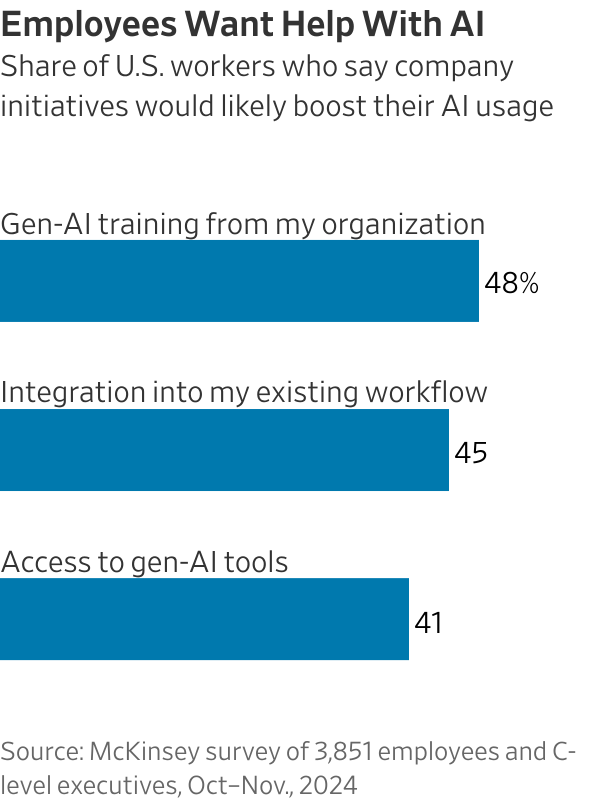
The real bottleneck to AI adoption is that it requires changing whole workflows inside of companies, which typically involve more than one person, he adds.
As a pair of academics wrote recently in MIT Sloan Management Review, “The barrier to full automation isn’t raw capability—it’s a stack of human, legal and cultural constraints.”
Modern AI adoption is yet another example of a concept first described way back in 1987, called Solow’s Paradox. At the time, economist Robert Solow was studying how newly integrated computers were affecting worker productivity. His finding: They weren’t, at all.
In this productivity paradox, all that spending on shiny new computers and the digitization of work processes didn’t seem to make companies any more efficient or effective.
Years later, adoption of information technology did start to show up in economics statistics. It turns out that just handing people tech doesn’t do much—it might even slow them down. It takes time for the work processes inside of companies to be reorganized and refined around new information technologies.
This lag is being repeated today, and for the same reasons. Adopting AI takes organizational change, similar to what happened in the past with the adoption of the PC, the internet, the cloud and mobile. And employees can’t do it on their own. Strong leadership is another key ingredient.
Making AI a priority
To see this play out, look at LogicMonitor. The company, founded in 2007, makes software to tell IT staff what programs are running on their company’s computers. LogicMonitor’s leadership recently decided to go all-in on generative AI.
This started with companywide access to ChatGPT Enterprise, and—just as important—a directive from its C-suite that everyone should experiment with it.
As a result, 96% of LogicMonitor’s employees are at least playing around with AI. Teams including sales, legal and engineering have created more than 1,600 custom chatbots to aid with basic tasks, from prepping sales calls to knowing what questions to ask when creating contracts for clients.
The company’s senior executives and other leaders contributed one in every eight of the custom chatbots, says Alyene Schneidewind, LogicMonitor’s chief performance officer. “I love that we’ve got top-down usage,” she adds.
When LogicMonitor commissioned Workhelix to evaluate who actually was adopting AI, the company found that a cohort of early-career engineers based in India were leading the charge. Based on these results, LogicMonitor plans to encourage its senior, U.S.-based software engineers to use more AI, says Schneidewind.
According to that July study from Microsoft Research, the jobs where AI is most applicable are ones that primarily involve research and writing. Many people in fields dominated by these tasks are certainly seeing disruption and job loss. But many fields that Microsoft highlighted as having the greatest potential to be affected by AI—including those historians!—are the ones where adoption is lagging.
Soon after Microsoft Research published that report, its authors took pains to point out that they weren’t trying to predict who would lose jobs to AI. Rather, they just wanted to figure out who might find the technology the most useful.
The real message: Most people, in most professions, have only just begun to adopt AI.
The most avid adopters and users of AI are among early career rank-and-file workers. They’re less set in their ways, and they feel intense pressure to use AI to make themselves more valuable to bosses and attractive to prospective employers. But leaders themselves need to learn from those eager beavers.
Eventually, AI holdouts will either get onboard or get weeded out. There’s a maxim, growing more potent every day, that AI won’t take your job, but someone using AI might. The same goes for companies.
Write to Christopher Mims at christopher.mims@wsj.com