

For more than 100 years, scientists studying space have watched the bright stream of material shooting out from the center of the massive elliptical galaxy M87. Now, the James Webb Space Telescope has captured the most detailed infrared image of this event to date.
This discovery unveils previously unseen characteristics of the jet emitted from the central black hole, notably the identification of its long-sought counterpart stretching in the other way. The photograph displays a vibrant pink streak expanding against a hazy purple backdrop, punctuated by luminous nodes indicating regions where particles are accelerated to near-light speed.
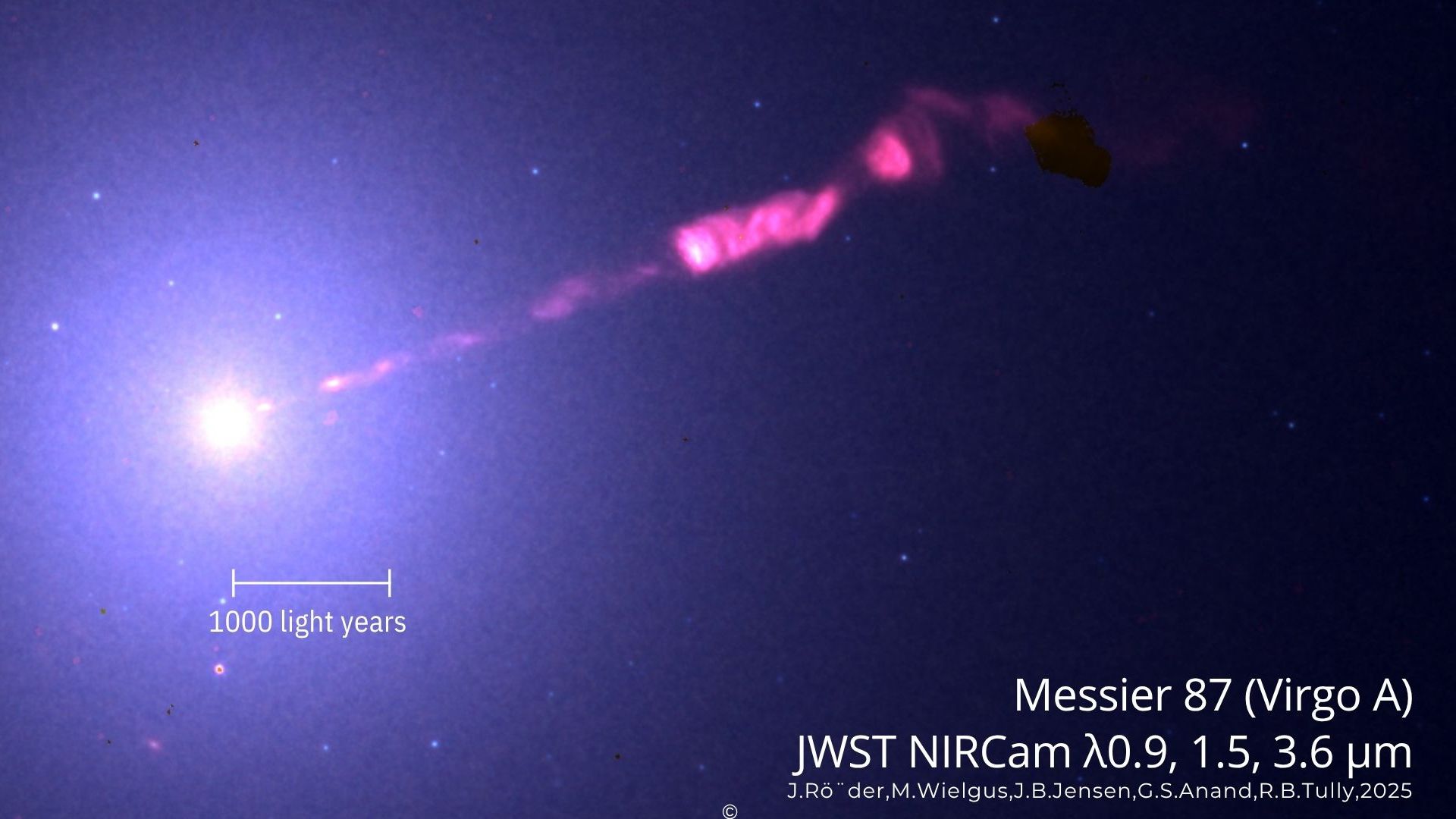
Using infrared vision for the first time, Webb has imaged the counter-jet roughly 6,000 light-years from the black hole. This feature is exceptionally dim and hard to spot because it’s receding from Earth at near light speed, which reduces its emitted radiation. The M87 galaxy, situated 55 million light-years away and found by Charles Messier in the 1700s, contains the supermassive black hole M87* at its core, which gained notoriety in 2019 when it was directly “photographed” for the first time.
Jan Röder’s research group employed Webb’s NIRCam to capture images of the jet across four distinct infrared wavelengths. Through careful removal of light originating from stars, dust, and distant galaxies, the team produced the most comprehensive infrared depiction of M87’s emission ever achieved. Close to the galaxy’s center, the jet exhibits a spiral form with intricate features that expose the behavior of particles.
The latest information supports the idea that the jet emits light via synchrotron radiation, which is produced when charged particles move in a spiral pattern within magnetic fields. The team examined slight differences in color across various infrared ranges, allowing them to follow the acceleration, cooling, and twisting of particles as they move along the jet. This research offers important insights into the intense physical phenomena taking place close to supermassive black holes.
These celestial jets provide ideal settings to examine physics under the most intense conditions imaginable in the cosmos. Driven by the power of supermassive black holes, they can boost particles to energy levels that dwarf anything achievable on our planet. Investigating these occurrences allows astronomers to solve the puzzles of how black holes affect the galaxies they reside in and the arrangement of matter across the vast intergalactic voids.
Synchrotron radiation
Synchrotron radiation is a unique form of electromagnetic radiation generated when charged particles, like electrons, are accelerated to near the speed of light within a magnetic field. This radiation differs from heat-generated light, arising instead from the acceleration of particles as they trace curved paths due to magnetic forces.
This effect is a natural occurrence in the cosmos, particularly near intense celestial bodies such as black holes. However, it can also be replicated here on Earth using specialized equipment known as synchrotrons. These substantial scientific tools enable scientists to probe the structure of matter at the atomic and molecular levels by harnessing this powerful radiation.
Regarding the jet emanating from M87, synchrotron radiation allows researchers to chart the configuration of magnetic fields and decipher the process by which energy travels from the black hole to the jet. The hue and brightness of this light reveal details about the velocity of particles and the power of the existing magnetic fields.
Examining this radiation across the spectrum, spanning from infrared to X-rays, provides an in-depth understanding of how particles accelerate in the cosmos, uncovering information that would be unattainable through alternative observational techniques.
Source: Astronomy and Astrophysics
Similar topics
- 💥 The black hole pulsar: a celestial body that has astrophysicists scratching their heads.
- Unknown object in space emits signals with unprecedented regularity 🛰
- What are the reasons behind black holes emitting matter jets, and what mechanisms are involved?
- A surprising connection discovered between black hole jets and the galaxies they reside in.